The Science of Void: From Taoist Emptiness to Brain Decluttering | XERLIFE+ Journal
老子在《道德经》第十一章说了一句话,被认为是建筑史上最早的”空间宣言”:”埏埴以为器,当其无,有器之用。凿户牖以为室,当其无,有室之用。”翻译成白话:揉土做碗,真正有用的不是碗壁,是碗中间那个”空”。开窗造房子,真正有用的不是墙和屋顶,是墙围出来的那个”空”。
老子在两千多年前就看透了一个现代认知神经科学才验证的真相:大脑需要”空”才能工作。
在神经科学中,这对应一个核心概念:认知负荷(Cognitive Load)。你的前额叶——负责决策、判断、创意的大脑区域——每时每刻都在处理信息。视觉、听觉、触觉、情绪信号。当认知负荷过高,前额叶的工作记忆被占满,你就出现注意力涣散、决定困难、莫名烦躁、创意枯竭。
在一个”留白充分”的空间里,视觉皮层只需处理最少的元素,能量消耗下降。前额叶不再需要持续过滤无关信息,工作记忆释放。默认模式网络被激活——创造力、洞察力、情绪恢复同步启动。你觉得”这房间好舒服”的瞬间,其实是你的神经元在欢呼:终于不用加班了。
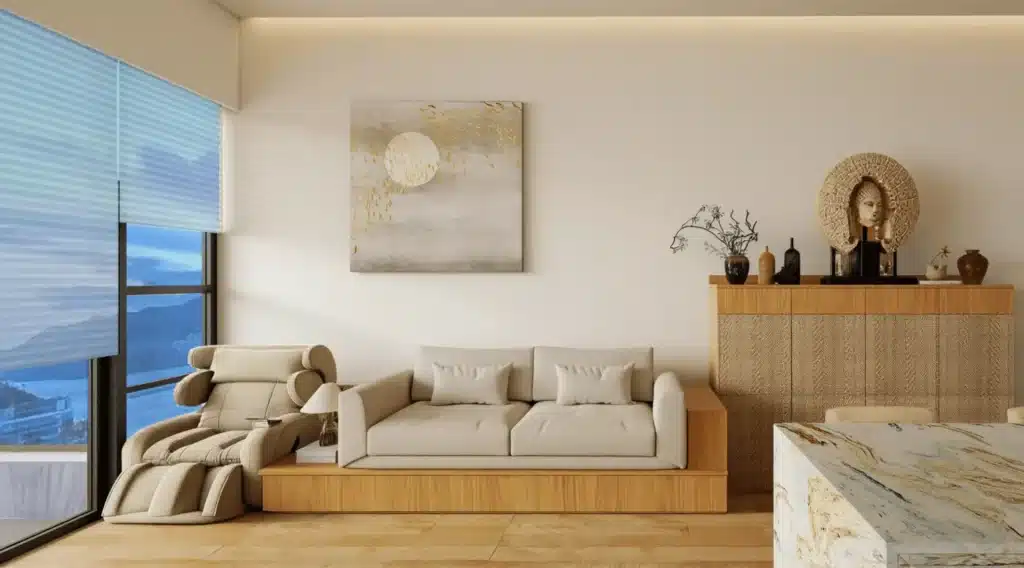
三个层次的留白。物理留白:减少家具密度,避免堆砌装饰。不是面积要大,而是视觉密度要低。一间十平米的房间也可以非常空旷——只要你不塞满东西。节奏留白:在空间序列中留出停顿。从嘈杂的入口到安静的室内,中间需要一个过渡区域——这是从警觉到放松的神经切换区。时间留白:一个会随着季节变化的空空间——春天有光,秋天有影,冬天只有静——让自然的节奏填满虚空间。比任何装饰画都丰富。
最好的设计,不是你加了多少,而是你敢留多少。
In Chapter 11 of the Tao Te Ching, Laozi wrote what many consider architecture’s earliest “spatial manifesto”: “Clay is shaped into a vessel; it is the emptiness within that makes it useful. Doors and windows are cut to make a room; it is the emptiness that makes the room useful.” In plain terms: you knead clay to make a bowl—what’s truly useful isn’t the clay walls but the empty space inside. You build walls and a roof—what’s truly useful isn’t the structure but the void it encloses.
Over two thousand years ago, Laozi grasped a truth that modern cognitive neuroscience has only recently confirmed: the brain needs emptiness to function.
In neuroscience, this maps to a core concept: Cognitive Load. Your prefrontal cortex—the region responsible for decisions, judgment, and creativity—processes information constantly. Visual input, sounds, tactile sensations, emotional signals. When cognitive load is too high and working memory is maxed out, you experience scattered attention, decision paralysis, free-floating irritability, and creative blocks.
In a space with sufficient void, the visual cortex processes minimal elements—energy consumption drops. The prefrontal cortex no longer has to filter irrelevant information—working memory is freed. The Default Mode Network activates, and creativity, insight, and emotional recovery all kick in. That moment when you think “this room feels so good” is actually your neurons celebrating: finally off the clock.
Three levels of void. Physical void: reduce furniture density, avoid decorative clutter. It’s not about square meters—it’s about low visual density. A ten-square-meter room can feel spacious—as long as you don’t fill it. Rhythmic void: leave pauses in the spatial sequence. Between a noisy entrance and a quiet interior, you need a transition zone—a neural switch from alertness to relaxation. Temporal void: an empty space that changes with the seasons—light in spring, shadows in autumn, stillness in winter—letting nature’s rhythm fill the void. Richer than any wall art.
The best design isn’t measured by what you add—it’s measured by what you dare to leave out.
Related Reading