The Hollow Fills: Everyone Loves to Sit Low — Your Home Needs a Hollow | XERLIFE+ Journal
你有没有注意过:一群人参观样板间,最后都挤在下沉式客厅里不想走;咖啡馆里,位置最低的沙发区总是最先坐满;连小孩子,都天然爱往地上的凹坑和角落里钻。
人,天生喜欢”低一点”的位置。
老子在《道德经》第二十二章说:”洼则盈,敝则新。”低洼的地方,水才会流进来填满它。放到空间里:一个往下凹的区域,天然有种汇聚感——人坐进去,像被接住、被包裹,心里反而”满了”。
这不是玄学,是环境心理学里公认的”瞭望—庇护”理论:人类天然偏好那些”既能看清周围、又不被完全暴露”的位置。远古时代,这样的位置既能发现危险,又能躲避危险,生存率最高;这份偏好刻进了基因,直到今天还在替你选座位:开会挑角落、等车靠墙站、吃火锅坐卡座——都是同一个本能在悄悄做主。
研究普遍发现:坐在有靠背、有遮挡、视线开阔的低处时,人的警戒水平会明显下降,身体更容易放松——因为大脑判定:”这里安全,可以休息了。”
那怎么在家里做出一个”洼”?三个做法。
第一,下沉式客厅。把会客区整体降下一两级台阶,坐进去的时候,视线刚好与站立的人平齐,既被空间”抱住”,又能看清全屋。一个下沉区,就能让整个客厅有了主心骨。下沉区的边缘还可以做一圈矮座,坐得下的人更多,包裹感也更强。
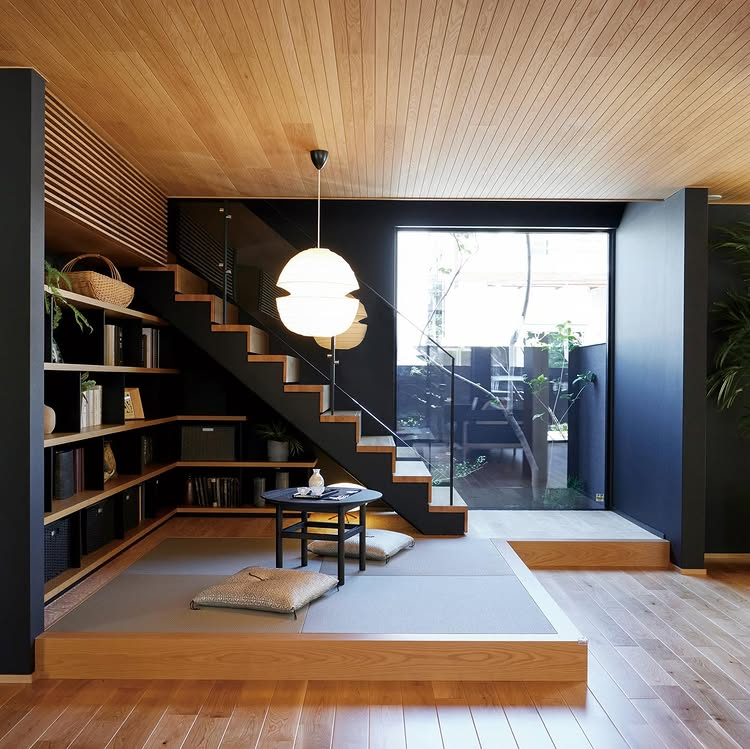
第二,地台。书房、卧室、阳台做一块抬高的地台,铺上垫子,变成坐卧皆可的区域。地台的边缘本身就是一种包裹——人坐在上面,像坐在自己的岛上。高度不用高,一级台阶的落差,就足够让大脑分清”台上”和”台下”。
第三,低矮座位区。一组矮沙发、几个落地坐垫、一圈围合式卡座,配上矮茶几。坐得越低,身体越松弛,聊天的氛围也越亲密。
记住一个原则:低处的座位,背后一定要有”靠”——实体墙、高靠背、书架都行。有靠的洼地才是安全的洼地,没靠的低处只会让人心慌。
房子不必处处高挑,有一处低洼,家就有了怀抱。
你的家不是用来看的,是用来养你的大脑的。
Have you noticed: when a group tours a show apartment, everyone ends up crowding into the sunken living room and not wanting to leave; in cafés, the lowest sofa area is always the first to fill up; even children naturally gravitate toward hollows and corners on the ground.
Humans are born loving positions that are “a little lower.”
In Chapter 22 of the Tao Te Ching, Laozi says: “The hollow fills; the worn becomes new.” Water flows into low places and fills them. Applied to space: a sunken area naturally gathers — sit into it, and you feel caught, held, and inwardly “full.”
This isn’t mysticism — it’s the well-established “prospect-refuge” theory of environmental psychology: humans naturally prefer positions “where you can see the surroundings clearly without being fully exposed.” In ancient times, such positions let you both spot danger and evade it — the highest survival odds. This preference is etched into our genes, and it still picks your seats today: choosing the corner seat in meetings, standing against a wall while waiting, taking a booth for hotpot — the same instinct is quietly deciding.
Research consistently finds that when sitting low with a backrest, some cover, and an open view, people’s alertness drops noticeably and the body relaxes more easily — because the brain rules: “It’s safe here; rest is allowed.”
So how do you make a “hollow” at home? Three approaches.
First, a sunken living room. Lower the seating area by one or two steps; when you sit in, your eye level matches someone standing — you’re both “held” by the space and able to see the whole room. One sunken zone gives the entire living room its center of gravity. The edge of the sunken area can carry a ring of low seats — more people fit, and the sense of envelopment grows.
Second, a platform. In the study, bedroom, or balcony, raise a low platform, lay down cushions, and it becomes a sit-or- lie area. The platform’s edge is itself a kind of enclosure — sit on it and you’re on your own island. The height needn’t be much; a single step’s difference is enough for the brain to distinguish “on stage” from “off stage.”
Third, a low seating zone. A set of low sofas, a few floor cushions, a ring of booth-style seating, with a low coffee table. The lower you sit, the looser the body, and the more intimate the conversation.
Remember one principle: low seats must always have something “behind” — a solid wall, a tall backrest, a bookshelf all work. A hollow with support is a safe hollow; a low spot without support only makes people uneasy.
A house needn’t be lofty everywhere — with one low hollow, the home has an embrace.
Your home is not for looking at — it is for nurturing your brain.