Forgetting Each Other in the Rivers and Lakes: When Family Living Together Gets on Each Other’s Nerves, the Problem Is the Space | XERLIFE+ Journal
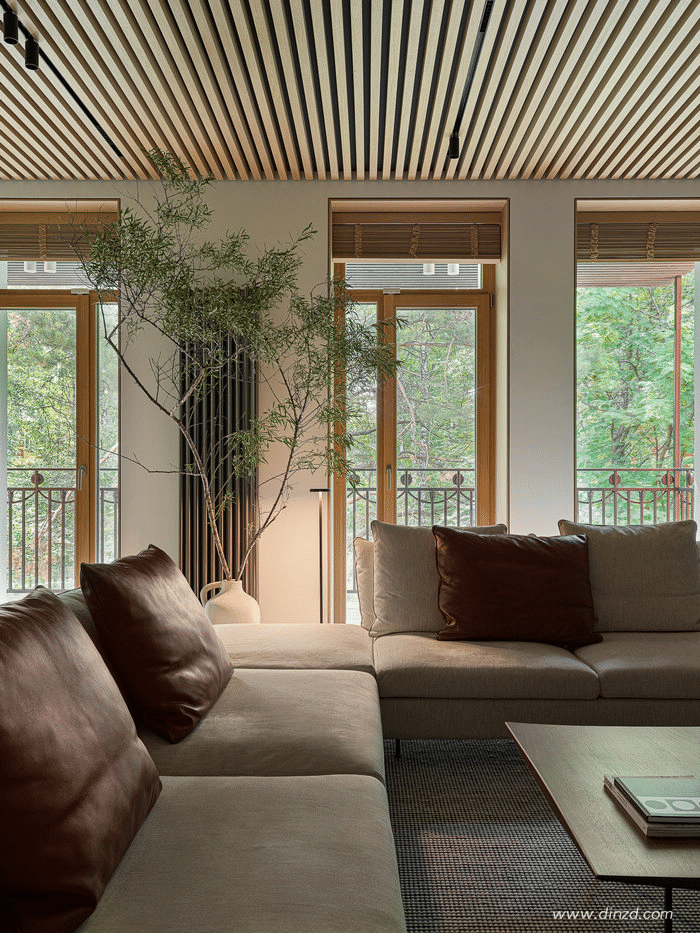
你有没有这种时刻:明明家人之间没有矛盾,但同一个屋檐下待久了,心里就是莫名地烦,忍不住想躲进自己房间?
别急着自责,庄子两千多年前就说过这件事。
《庄子·大宗师》里讲:泉水干了,两条鱼被困在陆地上,互相吐口水湿润对方——”相濡以沫,不如相忘于江湖”。与其靠彼此”打气”才能活命,不如回到江湖里,各自自在游动,彼此”忘记”。
相忘,不是绝情,而是各自有各自的水域。
脑科学里有个概念叫”个人空间”(proxemics):人与人之间存在一个无形的距离圈,被持续侵入时,压力水平会悄悄上升。但奇怪的是,人又需要”看得见家人”——研究普遍发现,余光里能看到家人活动的安全感,比面对面互动更能让人放松。因为对视需要调动社交注意力,随时准备回应;而余光里的存在,什么都不需要你回应。也就是说,人既要距离,又要联系;要的是”看得见,但不用说话”的陪伴。
家庭空间的设计,就是要造出这种”江湖感”:彼此照见,互不打扰。
第一,用半开放隔断。玻璃隔断、矮柜、格栅屏风——视线是通的,声音和行为却是分开的。你在厨房做饭,孩子在客厅写作业,互相在视野里,又各有领地。
第二,一人一个”角落”。给每个家庭成员一张书桌、一把单人椅、一小块”我的地盘”。角落不用大,但要有”闲人免入”的默契。
第三,共享区放在”看得见”的位置。餐桌、沙发区,安排在家人动线交汇的地方,让”软注视”自然发生——不用刻意互动,余光里有人,家就有温度。
第四,给”独处”正名。一个人待在角落看手机,不是冷落家人,是大脑在充电。让独处在家中有一个合法位置,家人之间的压力反而更小。
相濡以沫是感动,相忘于江湖是舒服。江湖不是一个很大的空间,而是一种不被打扰的自由。家最好的状态,不是一家人黏成一团,而是各自有江湖,回头就能看见彼此。
你的家不是用来看的,是用来养你的大脑的。
Have you ever had this moment: there’s no conflict between family members, yet after a long time under the same roof, you feel inexplicably irritated and can’t help wanting to retreat into your own room?
Don’t rush to blame yourself — Zhuangzi talked about this two thousand years ago.
In the “Great Ancestral Teacher,” the story goes: when the spring runs dry, two fish are stranded on land, moistening each other with their saliva — “better to forget each other in the rivers and lakes than to keep each other alive with spit.” Rather than depending on mutual “encouragement” to survive, better to return to the rivers and lakes, each swimming freely, “forgetting” the other.
Forgetting is not heartlessness — it means each has their own waters.
Brain science has a concept called proxemics: there is an invisible distance ring between people, and when it is continuously invaded, stress levels quietly rise. But oddly, people also need to “see their family” — research consistently finds that the sense of safety from seeing family members move in one’s peripheral vision relaxes people more than face-to-face interaction. Because eye contact demands social attention, always ready to respond; while a presence in the periphery requires nothing from you. In other words, people need both distance and connection — what they want is “visible, but no need to talk” companionship.
Family space design is about creating this “rivers and lakes” feeling: seeing each other, without disturbing each other.
First, use semi-open partitions. Glass dividers, low cabinets, lattice screens — the sightline passes through, while sound and activity stay separated. You cook in the kitchen, your child does homework in the living room — each in the other’s field of view, yet each in their own territory.
Second, give everyone “a corner.” Each family member gets a desk, a single chair, a small patch of “my turf.” The corner needn’t be large, but it must carry the tacit understanding of “no entry.”
Third, place shared zones where they can be “seen.” The dining table and sofa area should sit where family circulation paths converge, letting “soft gazes” happen naturally — no deliberate interaction; when someone is in your peripheral vision, the home has warmth.
Fourth, legitimize “being alone.” One person sitting in a corner looking at their phone is not ignoring the family — it’s the brain recharging. Give solitude a legitimate place in the home, and the pressure between family members actually eases.
“Moistening each other with spit” is touching; “forgetting each other in the rivers and lakes” is comfortable. The rivers and lakes are not a very large space — they are an unbothered freedom. The best state of a home is not a family glued together, but each having their own waters, and turning around to see each other.
Your home is not for looking at — it is for nurturing your brain.