Softness Overcomes Hardness: Sharp Corners Keep Your Brain Clenching Its Fist | XERLIFE+ Journal
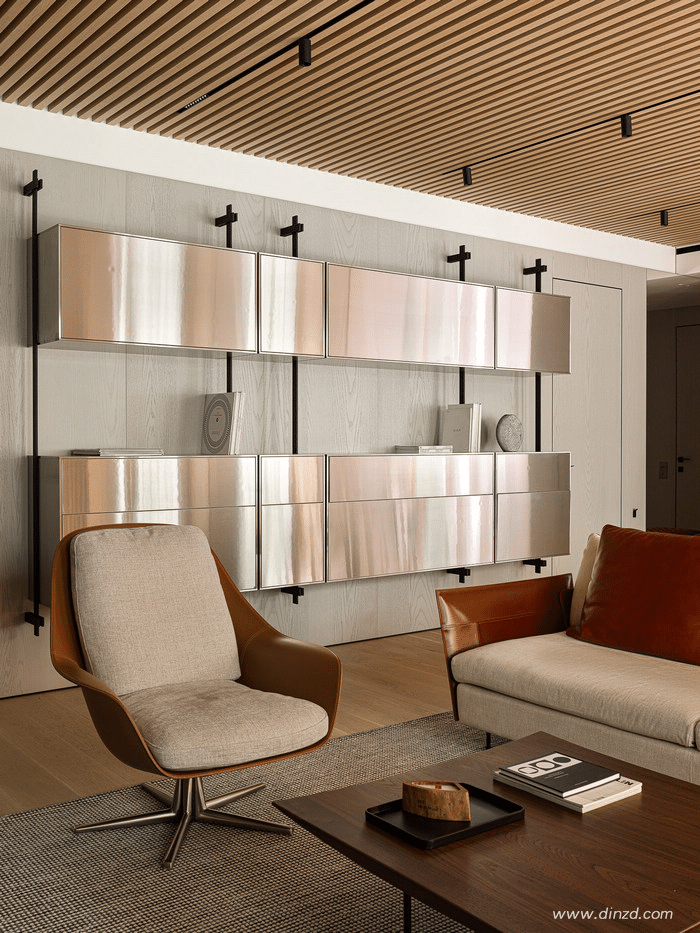
你有没有过这种感觉:坐在客厅里,余光扫到茶几的尖角、柜子的直角、电视墙的折线,明明什么也没发生,心里却莫名地绷着。住惯了圆角家具的人再住回直角房,总觉得浑身不自在。说不清哪里不对,但身体很诚实。
老子在《道德经》第七十八章说:”天下莫柔弱于水,而攻坚强者莫之能胜。弱之胜强,柔之胜刚。”天下没有比水更柔弱的东西,可攻克坚强的东西没有能胜过它的。水没有固定的形状,却能改变一切形状;不争不抢,却无孔不入。柔弱胜过刚强,柔韧胜过坚硬——这是水的哲学,也是空间的哲学。
为什么”硬”会让人紧张?因为大脑里有个叫杏仁核的情绪警报器,专门负责检测威胁。神经科学普遍发现,尖锐的物体、锋利的边角会触发这套威胁感知系统——哪怕你根本没有注意到它们,身体已经悄悄进入了”防御模式”。而圆角和曲线完全不同:视线沿着弧线滑过去,没有停顿、没有卡点,视觉加工一路流畅,身体也跟着放松下来。研究普遍发现,人对曲线比对直线更容易感到安全与舒适,这种偏好几乎是本能的,不需要学习。这也是为什么医院、幼儿园、养老院几乎见不到直角——最需要安全感的地方,早就替我们想明白了。
给家”去刚强”,有四招。
第一,家具选圆角。茶几、餐桌、床头柜,能选圆角就不选直角。家里有孩子和老人,这更是刚需;哪怕只是把桌角磨成小圆角,紧绷感都会少一截。
第二,墙面做弧。转角墙改成弧形,走廊尽头做成圆润的收口,空间的”语气”立刻柔和下来。
第三,该软包就软包。床头、沙发靠背、飘窗坐垫,柔软的材料会吸收视线里多余的”硬度”,也让身体有地方靠。
第四,动线走曲线。家具别排成一条僵直的线,留一点弧度,走路、转身都更从容,家也跟着”活”起来。
一个家可以很有力量感,但那力量应该是水的力量——绕着障碍走,却无坚不摧。
你的家不是用来看的,是用来养你的大脑的。
Have you ever felt this: sitting in the living room, your peripheral vision catches the sharp corner of the coffee table, the right angle of a cabinet, the fold line of the TV wall — nothing has happened, yet your chest feels inexplicably tight. People who live with rounded furniture feel out of sorts when they move back into a right-angled room. You can’t say what’s wrong, but the body is honest.
In Chapter 78 of the Tao Te Ching, Laozi says: “Nothing under heaven is softer than water, yet nothing that attacks the hard and strong can surpass it. The weak overcome the strong; the soft overcome the hard.” Nothing is more yielding than water, yet nothing can match it at conquering the firm and strong. Water has no fixed shape, yet it changes every shape; it contends for nothing, yet penetrates everywhere. Softness overcomes hardness, suppleness overcomes rigidity — this is the philosophy of water, and the philosophy of space.
Why does “hardness” make people tense? Because the brain contains an emotional alarm called the amygdala, dedicated to detecting threats. Neuroscience consistently finds that sharp objects and acute edges trigger this threat-perception system — even when you never consciously notice them, your body has quietly slipped into “defense mode.” Rounded corners and curves are completely different: the gaze glides along the arc — no pauses, no snags, visual processing flows smoothly all the way, and the body relaxes along with it. Research consistently finds that people feel safer and more comfortable with curves than with straight lines — a preference that is almost instinctive, requiring no learning. This is why hospitals, kindergartens, and nursing homes have almost no right angles — the places that need safety most figured this out long ago.
To “remove hardness” from your home, four moves.
First, choose rounded furniture. Coffee tables, dining tables, nightstands — choose rounded over right-angled whenever possible. If you have children and elderly at home, this is a necessity; even just rounding the table corners slightly reduces the tension by a notch.
Second, curve the walls. Turn corner walls into arcs, finish corridor ends with soft curves — the space’s “tone” immediately softens.
Third, pad what should be padded. Headboards, sofa backs, window-seat cushions — soft materials absorb the excess “hardness” in your field of vision and give the body somewhere to lean.
Fourth, let circulation paths curve. Don’t line furniture up in one rigid row; leave a little arc, and walking and turning become more graceful — the home comes “alive” too.
A home can be full of strength — but that strength should be the strength of water: it flows around obstacles, yet nothing can break it.
Your home is not for looking at — it is for nurturing your brain.